Showing posts with label movies. Show all posts

Friday, January 16, 2015

The Hidden (to some people) Message of "The Interview"


Last night, "The Interview" was on at the Princess Cinema in Waterloo.  I went to see it on my own, as Mary Ann is not overly fond of fart jokes, sexist humour, and defying Kim Jon Un.

My initial interest in the movie was that I actually do find Seth Rogan's humour to be funny despite the occasional fart joke.  But then, when the full release of the movie at Christmas was cancelled because of threats from North Korea, it was of course my patriotic duty to see the movie at my local underground art movie theatre.

I had a few laughs, and was entertained all the way through.  But more importantly, I think there is a hidden message in the movie.  I say hidden, because apparently some people just didn't see it, although it is glaringly obvious.  This movie is a message about propaganda, not only in the movie itself, but the hype and controversy around the movie too. You can take it on many different ways.  One way to look at the movie, is that it is deliberate American propaganda, supported by the government agencies, to try and discredit Kim Jon Un. Another way to understand it is that North Korea is trying to block opposing propaganda with terror threats.  Or maybe the terror threats are all made up, as there is no hard evidence the North Koreans ever threatened anything other than their usual thermonuclear war.  Of course, thermonuclear war doesn't worry anyone in the USA, but the idea of a crazed Korean gunman wandering into a movie theatre somewhere does get people excited.

Inside the movie the subliminal message is that propaganda and manipulation is everywhere. Propaganda and manipulation are slightly different, in that manipulation is more on an individual basis, while propaganda is usually for the masses, but the lines are being blurred.  The CIA uses a "honeypot" manipulation to get our hero, Skylark, (James Franco) to cooperate in assassinating Kim Jong Un.  Skylark is easily manipulated by a beautiful female CIA agent wearing glasses (even though he later finds out the sexy glasses are as fake as everything else).  Skylark is also easily manipulated by Kim Jon Un, despite being adequately warned by Seth Rogan before meeting the Dear Leader and master of manipulation. Un comes across as a very likable guy, and even had me taken in during the movie.  How can you kill a guy that plays Katy Perry music in  his tank while doing a little artillery practice on local trees?  And wonders if Margaritas are too gay?  And gives you an adorable puppy that reminds you of the dog you had when you were growing up?

At the end of the movie I was truly shocked to find out that Kim Jong Un was actually a ruthless dictator who deserved to die. At least, if you can believe the propaganda.

Sunday, November 9, 2014

Is the Movie "Interstellar" Liberal or Conservative? (Subliminal Messages)

 I suspect that Interstellar's hidden message may be conservative, despite the seemingly liberal image of the Earth's environment collapsing.

This is not a review of the movie, it is an analysis of the hidden messages in the movie, and whether it is mainly conservative or liberal.  So there will be spoilers below.  And by the way, I don't think that the bias in the message is severe enough to spoil the movie for anyone.  I barely noticed it at the time.

On the face of it, we have America unable to feed itself, with the return of giant dust storms like the 1930's.  But more than just America, in the movie "Interstellar", the entire world is in the same state of environmental decline, and humans will not be able to survive another generation.

This could  be a liberal message because Liberals believe in global warming, and apparently, conservatives don't.  But actually, I think it is made clear in the movie that this destruction of the Earth is caused by blight or diseases ruining the crops.  If you are a die-hard Conservative, you can then assume that dead crops may be causing these dust storms, and not global warming.  However, this argument can be taken either way.  For example the severity of the Mountain Pine Beetle's recent destructiveness may be linked to climate change.

http://en.wikipedia.org/wiki/Mountain_pine_beetle


I hope I'm not misrepresenting the conservative point of view, but I think the Conservative point of view is sometimes stated like this: "we do not need to be careful of the environment, because human ingenuity will find a way to save us no matter how much destruction we cause."

I will put a quote and a link here to a conservative website doing a similar political analysis of this movie:

"there isn’t the slightest doubt that Nolan’s view of climate change is that it is simply another of the many environmental situations that man is equipped to cope with. In the context of the film, this means extreme actions that make for cinematically exciting scenes, but on an allegorical level Nolan is saying, “Mankind has the creativity to respond to crises, even global ones."

http://pjmedia.com/lifestyle/2014/11/07/5-conservative-themes-hidden-in-interstellar/4/

Is it truly a conservative viewpoint, that if the Earth is failing, we do not need to save the whole planet, we simply need save Humans, probably by getting us off planet Earth? And is it truly a liberal attitude that we need to preserve our planet because we believe that Humans are just evolved monkeys and therefore we are not smart enough to invent a way to survive? If so, then this movie's hidden message really is conservative. Because in the movie, mankind does discover two ways to survive beyond planet Earth.  At the end we see these giant spaceships, complete with farms, where people are living with no need for planet Earth.  And the movie also presents the possibility of colonizing one of the planets on the other side of the worm hole.

As a liberal watching the movie, I admit that I was simply not convinced that either of these survival plans was really possible.   I guess if I was a conservative, I may look at the movie thinking those survival strategies are reasonable, and that the destruction of the Earth is the really unlikely scenario. But it's the ending of the movie that points to the hidden message being truly conservative.  Those huge orbiting space colonies are the result of the scientific work by Murphy, solving the riddle of gravity, and thereby allowing humans to build these giant structures and lift them off the earth without much trouble.  But as far as I'm concerned, overcoming gravity is no more likely than black magic or holy miracles at this time.

Then, in case gravity was not defeated, "plan B", was to fly through a worm hole to another habitable planet.  But Plan B would not allow any more than a handful of existing humans  to survive. Those handful of humans that take this trip could take human genetic material to the new planet, and so regenerate the human race again, similar to Noah and the Ark.  Again, I am not aware of any theories that humans, or anything, really could get through a worm hole if they really exist.  So I think both Plan A and Plan B are just cop outs without any real scientific basis.

So we come back to planet Earth, and the big question: is it worth preserving or should we simply exploit our planet to the maximum then bug out?  What I find strangest is that preserving the Earth has become a Liberal point of view in recent years, while developing technology to escape the Earth used to be the Liberal point of view.  In the past, Conservatives were really all about "conserving" and liberals were all about scientific discoveries (such as evolution, DNA, nuclear physics, and the Earth is not flat).  Ironically, the people most intent on self destructing planet Earth today are not the scientists, they are the religious nuts who believe the end of times are at hand, and their political allies, the Conservatives.  But the theoretical scientists are the ones who have the best chance of inventing the technology needed to save us, and they are mostly liberal, working outside the corporate culture of short term profitability.

Friday, April 4, 2014

The Noah Movie Review: Do Cats Hate Water?


Last night I persuaded Mary Ann to go and see the new movie "Noah" at the cineplex.  I was intrigued by this movie, as it is a bible story, yet I see in the news that Fundamentalists hate it.  Apparently because it is historically inaccurate.  I think that Atheists may have the same objection.

Anyway, it stars Russell Crowe (Noah) who is not my favourite actor, but I don't hate him either. As Noah's  wife, Jennifer Connolly, who I like because she starred in Blood Diamond, but also don't like because she seems to be starving herself to death.

I hope this does not spoil anything, but this version of Noah solves some of the age old questions, like what did they do with all the animal poop, how did they feed all those animals for so long, and how did they stop the animals from killing each other?  I will reveal the secret here:  They put them to sleep (like hibernation) with some kind of burning plant smoke that does not affect humans.  Wasn't that easy?  The Holy Bible should have hired a few more Hollywood writers and it might have come off as more believable.

Now back to the movie.  The director had a radically different interpretation of the Noah story from the one most Christians cling to.  The normal Christian interpretation is that God is an angry God who is easily annoyed, and punishes mankind quite horribly when he is in a bad mood.  And sometimes even if He's in a good mood!  So bottom line: better worship God as hard as you can, as often as you can.

The writer and director of this movie was Darren Oronofsky.  His view is that a Creator made a nice planet, but one of his specially created species is greedy and cruel, and causing a bit of a problem by wiping out every other form of life.  I don't think I'm giving anything away by revealing that the problem species is Humans.  And so "The Creator" can only solve the problem by wiping out most of life on Earth with a flood, and starting over, either with Noah's family, or without humans altogether.

Oronofsky's vision is not too far off the vision of many environmentalists.  The environmentalist view is that humans are just one species of a complex ecosystem, and should learn to live within that ecosystem without destroying it.  On the other hand, the Fundamentalists seem to believe a man-shaped God created Man in his image, and that the entire rest of the universe was only created by God for a backdrop to Man.  In other words, they believe that a universe without "Man" makes no sense whatsoever.

Would you want to see this movie? Probably not, if you only want to see the cute animals  like giraffes and zebras and gorillas marching two by two up the gangplank.  You will see that, but you will also see a lot of killing, and just plain nastiness.  Also you will see just about everything that you normally find in an epic action movie starring Russell Crowe: monsters, battles, a lot of screaming and crying, man-to-man wrestling and swordplay.  But most of all, if you are a Biblical literalist, you will find a lot of offensive stuff on a philosophical level and on a "factual" level. (especially the constant reference to "the Creator" instead of "God".)  It's also not tremendously appealing to environmentalists, if Mary Ann is a representative sample.  Of course, her main objection was that everybody seemed to leave their empty popcorn and drink containers in the theatre instead of taking them out to the garbage.  "Is this the new culture?" she said disparagingly at the end. So apparently not a lot of environmentalist saw this movie, but it does have a powerful attraction for litterbugs.

Sunday, November 3, 2013

The Lost Motorcyclists' Review of "Larry Crowne"


Last night the movie "Larry Crowne" with Tom Hanks and Julia Roberts was on TV. I had wanted to see ever since it came out in theatres in 2011, but never got around to it.  I am always attracted to movies featuring motorcycles, and because of Mary Ann's Burgman scooter, I thought she might be interested in going to Larry Crowne.  But she wasn't, really.

When it came on TV I decided to watch it myself, as Mary Ann still had better things to do.  As I watched the movie, I thought I noticed in one quick scene, that Larry Crowne, played by Tom Hanks, was reading "Zen and the Art of Motorcycle Maintenance".  I wasn't sure, so I googled it and found out that it was true.  And at the same time I came across a conservative website that blasted Larry Crowne for being too liberal in its views.  They also awarded it with only a half "Reagan" (their unit of film stars), and even funnier, at the end of the review they changed their award to a half "Marx" as it was supposedly so extreme to be considered communist/socialist propaganda.

http://www.debbieschlussel.com/39351/wknd-box-office-transformers-dark-of-the-moon-larry-crowne-monte-carlo/

After Debbie Schlussel's harsh review of such an innocuous film, I simply had to do a blog about it.

What were Debbie's complaints?  First was that Larry Crowne was fired by UMart, which she perceived as a thinly veiled jab at Wal-Mart.  So apparently being against Wal-Mart brands you as a pinko, is that true?  Maybe it is. After all Mary Ann and I try to avoid going to Walmart, and extreme conservatives would label us at the very least as as liberals.  (Mary Ann's Wal-Mart boycott is more effective than mine, but still has failed to bring it to its knees.)  Many of the angry Tom Hanks hating commentators, on Debbie's blog, point out that Wal-Mart would never fire somebody like Tom Hanks, who served in the US Navy, and is regularly employee of the month.  Actually one of the conservatives' most beloved legends is that of the retired navy admiral serving as a humble Wal-Mart greeter.

Here is a link to a conservative website that in turn links back to my blog where I am poking fun at the right wing forwarded email about the retired admiral.  I guess my dry humour does not go over too well in some cases.

http://www.godlikeproductions.com/forum1/message1841851/pg1

Tom Hanks was fired during a routine employee cull, where his lack of education got him a red flag.  Actually, not so much a lack of education, as it seems that even just enrolling in college would have spared him getting the axe.  Larry's understanding of the economic system is so weak that he thinks he was "downsized".

So the firing of Tom Hanks has all kinds of ideological implications.  The Conservative view of America is that serving in the military and  working Wal-Mart jobs are good enough to sustain the lifestyle of driving huge SUV's and buying monster homes in the suburbs. Tom Hanks finds out differently when he takes a course in economics at a local community college after he is fired.  And he does not learn about trickle-down free market capitalism either.  There's another good reason to give this movie a half a Marx.

Tom Hank's (I mean Larry Crowne's) education in economics ends up with him dumping his house and buying a scooter to save gas. Actually, to be fair, the idea of buying the scooter came before the economics course.

Another serious complaint about Larry Crowne is that it apparently reverses the Conservative stereotype of willingly subservient women and dominating macho men.  The romantic interests are Tom Hanks and Julia Roberts.  Tom hanks plays a very nice guy throughout the movie, as Tom Hanks often does.  Julia Roberts comes off as kind of bitchy, impatient, hard drinking, bossy, petulant, aggressive, demanding etc., and this does not sit well with conservatives who claim that she is actually playing the man's role, while Tom is playing the woman's.

Another target for conservative ire was the fact that Julia Roberts gave Larry Crowne an A+, seemingly just because she was attracted to him romantically.  Of course this is unethical (if it is true, which it may not be), and I don't think it's fair for conservatives to be harping on this point as if it is a flaw of liberalism. But grading people's speeches is always a bit of a subjective affair, and always open to accusations of favouritism. I once took a community college course, many years ago in computer programming,  where the professor let us give ourselves our own grade at the end. He questioned a guy sitting a few rows back on his self awarded C.  "Why did you give yourself a C?"  "Because I didn't fart too much during classes."  The C stood.  I gave myself an A, and he didn't question it, and I don't actually think it made a bit of difference to my life whether I got a C or an A in that course.

Here is a link to another review, in which "Larry Crowne" is called one of the best movies of the year.

http://brightlightsfilm.com/74/74happy_markel.php#.UnZEu0imc7w

Picture: I got my picture of Larry Crowne reading Zen and the Art of Motorcycle Maintenance out of this second review, where it was correctly attributed.  One of the commentators of the conservative blog called it "Zen and the Art of Motorcycle Riding".  Does that mean one of my favourite books is actually a liberal book?  I really never considered the possibility until now, when a conservative does not get the title right, and the book appears as a prop in a liberal movie.

Tuesday, April 30, 2013

A Day in Toronto


Our nephew, Andrew Moir, had a film he made called "Just as I Remember" showing at the "Hot Docs" film festival in Toronto.  Hot Docs is a festival for documentary films, and although it is smaller than the Toronto International Film Festival (or TIFF), it is still quite a big deal by our standards, showing about 250 documentary films.  A link to the IMDB synopsis of Andrew's film is here:

http://www.imdb.com/title/tt2212234/

Since December 2011, there has been a commuter train, called the GO train, that runs from Kitchener to Toronto.  We both like rail travel, even though we rarely travel that way in North America. So we decided to try it out.  There are only two trains a day from Kitchener running into Toronto, the last one being 7:07 AM.  Convenient for commuters, not so good for tourists going to a 4:00 PM movie, but .. oh well.  At least we can walk to the train station from our house.  And the train is a double decker, so I imagined the view from the top would be pretty good.  Actually, the upper deck is not really that high, as the lower deck is near the ground.  Also, the tracks do not often run at ground level, so I never got much of a feeling of being up high except when we were next to the station.  But it was fun seeing the back yards of all these houses and businesses on the way in to Toronto.

https://en.wikipedia.org/wiki/Kitchener_line

Paying for the train was a learning experience.  As it is a commuter train, apparently they do not have a person selling tickets at the train station. (machines are no good, because we need to ask dumb questions)  So a few days earlier, we went to the Kitchener bus station, where we ended up buying a "Presto Card" pass.  This card is loaded with a certain amount of money, and each time you make a trip, you touch the card to a reader to get on, and then touch it again to get off.  If you forget to touch it getting on, you can be fined, if they catch you.  If you forget to touch getting off, your card will continue to pay for the train that you are no longer on, until the card is worthless.  OK, a little bit scary, but we can handle it.  We loaded up our two cards with exactly the amount of money for a return trip to Toronto.  When we got to the train station, we found out, by watching other people, where the Presto card tapping post was (not on the train, but on the platform!). Then we walked to the place where the front car would be, thinking we would get a good view.  This was a long walk, because the train has ten double decker cars, but because it also has two separate locomotive engines, we could not see to the front, and we couldn't even give the driver advice.

The complications continue.  We needed to return abut 9 PM, but the last train would have already left.  But GO Busses keep running, so the last bus back to Kitchener would be around 11 PM, although we would need a transfer at Mississauga.  Although this setup seemed complicated, we went ahead with the plan.  But then we met another nephew at the film, who offered us a ride home, so our Presto Passes are still left with about $15 each unused on them.  But that money can be used at a later date if we want to go to Toronto again.  (and we probably do.)

It was a misty day in Toronto on April 29, but we never got caught in any rain.  We arrived at Union Station about 9:00 and immediately compromised our health by going to Cinnebon for coffee and one of those things that cinnebon sells.  (I just call it a cinnebon, but I'm sure it has a name).  I always go there on my way to the December motorcycle show, it's a hard habit to break when you smell the cinnebons baking.  Then Mary Ann wanted to see the Skywalk, going from Union Station to the Convention Centre.  Across from the Convention Centre, is the Roundhouse Park.  It is an outdoor museum of trains, and in the actual roundhouse is the Steamwhistle Brewery, with free beer and $10 brewery tours.  Unfortunately they did not open until 12:00, and we had other things to see.  It only took about 20 minutes walking from Union Station to the Entertainment District, where the film was playing later at the TIFF Lightbox Theatre. So to kill more time, we walked about 20 minutes further to see the Kensington Market. Mary Ann likes markets, so this was a good walk, as we also passed through Chinatown on the way to Kensington.

The Kensington Market is not one big market building, it is an area covering several blocks around Kensington Avenue, where there are lots of little businesses. As you turn the corner from Dundas onto Kensington, you are instantly struck by the funkiness of it all.  And actually Dundas is quite funky, too, but in a different way, as it is still Chinatown.  Kensington has graffiti, narrow streets, motorcycles, bicycles and scooters parked everywhere. Many people look like they are either from the fifties, or possible from some alternate post apocalyptic universe.  And this is still early Monday morning.

In the afternoon, we met up with some of Mary Ann's family who had come to see the film.  The theatre was normal size, I don't know why I expected it to be a small screening room.  And surprisingly (to me) it looked about 3/4 full, or maybe more.  Not just family members either.  They mostly went to the Saturday showing, which was sold out.  That's why we had to go Monday. Andrew's film was under 20 minutes, but was being shown together with a longer documentary, so it felt like watching a normal length movie.

So now we are home again, and with our partly used Presto cards, we will find it much easier to plan our next outing to Toronto.

Saturday, December 1, 2012

Comparing 2 Movies "The Time Machine" and "Chasing Ice"

 I watched the movie "Chasing Ice" last night, and a few days ago, I also saw a 1960 movie by George Pal, "The Time Machine". The first similarity that struck me was the use of time lapse photography in both movies.  In case you have never seen this classic movie, The Time Machine, maybe you want to skip this review that includes spoilers.  Now go and see the movie, or maybe read the book.

The Time Machine is based on an H.G. Wells science fiction book from 1895, where someone invents a time machine and travels forward 800,000 years to the future to see how the world has progressed. The time lapse photography is used to simulate the effect of moving forward rapidly through time to the future.

Chasing Ice is a documentary by James Balog about our world's beautiful but disappearing ice landscapes.  In this documentary, time lapse photography is used to speed up the shrinking of glaciers so that you can see in one minute, what took five years to occur naturally.

In a way, both movies are about the same thing.   They are predicting the future, and have something to say about humans causing this future.  The main difference is that "The Time Machine" has to go forward 800,000 years to see what will happen, while Chasing Ice only needs to go from 5 years ago to the present time, to see what will happen.  Chasing Ice needs no time machine, nor does it need to  invent a future. It is enough to show what has happened in the last five years, and from there, scientists have told us what will happen next.

In The Time Machine, no global warming seems to be happening.  H. G. Wells is more worried about what will happen to mankind, if the gap between the rich and poor increases, and if we continue having wars with technologically advanced weapons.  According to his vision, 800,000 years in the future, the rich classes (called the Eloi) will have lost their energy and will to succeed, while the working classes (called the Morlocks) have moved underground, and evolved into a different species that now uses the Eloi as feeding stock.  H.G. Wells explains this in terms of evolution and predictable outcomes of social and economic forces.  However he does seem to be discouraged that the Eloi have no will to resist the Morlocks, nor any desire to even rescue each other when danger looms.  The Eloi seem like brainwashed zombies sleepwalking to their doom, not curious about what is happening or why.  The Morlocks, while looking like beasts, at least have drive, cunning, and curiosity.

Now here is where another parallel appears.  If you believe the rapid warming of the planet may have disastrous consequences, then we are already in some ways like the Eloi.  Because humans taken as a whole, do not seem to have the will or even the curiosity to fight back.  Mankind has the same attitude as the Eloi in that we simply accept what will happen.  Another similarity is that our present situation is being controlled and manipulated by present day Morlocks.  I don't mean that they look scary or anything, but there seems to be a split between rich and poor that is growing.  I'm going to call the Morlocks the rich, who benefit materially from a passive working middle class.  I don't mean to imply that the present day Morlocks are eating the present day Eloi.  They are just using them to get richer and more powerful.  And cynically manipulating them through controlled messages on TV, Internet, newspapers, and radio.

H.G. Wells' original Morlocks actually evolved from the poor and working classes, while the Eloi evolved from the rich idle classes.  I'm not sure this is made abundantly clear in the movie, but I read the book after I saw the movie.  The book is far more left wing in it's attitude than a movie (which was made during the cold war) could ever be, and Wells' opinions are made clearer in the book.

My interpretation of Chasing Ice in 2012 has the Morlocks and Eloi in role reversal,  but I think the main point is that in both movies mankind is passively accepting a situation that is within their grasp to change.  And in both movies there exists a class divide that pits an aggressive class against a passive class.

In the end, both movies are looking at how the world changes.  But for H.G. Wells, the changes are so slow as to require 800,000 years and a time machine to see.  For we humans of 2012, cataclysmic changes are so speeded up that a time machine is superfluous.

Wednesday, September 19, 2012

Free Speech that Helps Terrorists


So here we come to the latest free speech argument, the anti Moslem movie called "Innocence of Muslims" that has apparently provoked a storm of violence in the Muslim world, and resulted in the death of the US ambassador to Libya.  It is not really clear in my mind, who made this movie, but it seems very clear that the movie is ideally suited to ruffling the feathers of  Muslims.  As far as I can see, the movie has no other value, as it us unfunny, inaccurate, and uninteresting.

One thing that no one else seems to be willing to mention about the movie "Innocence of Muslims":  Was it made for the specific purpose of helping Al Quaida?  The reason I ask, is because it has no other useful purpose due to its low quality and crudeness.  And if its only purpose is to promote terrorism, couldn't we start by investigating the background of the people who made the movie, to find out if they are secret Al Quaida sympathisers?  I'm not in favour of torture, but with a little waterboarding you could probably make the director confess to being a member of an Al Quaida sleeper cell, then record his confession and play it on TV.*  That should quell the violence and rioting a little.

But now let's take a closer look at the free speech issue, which is used to defend the movie. I believe free speech is becoming one of the right wing conservatives favourite values.  Why do they favour free speech, and why do liberals seemingly oppose free speech?  Well, first of all I don't think liberals oppose free speech.  But liberals take a dim view of racist propaganda that encourages violence against women and minorities.  Actually, everybody regardless of their political persuasion hates people who shout fire in a crowded theatre, (unless there really is a fire).  So liberals are actually in favour of free speech, but don't really know how to handle intolerant, racist, and violent opinions of others.  Conservatives do not really believe in free speech, and use the current tolerant social climate favouring free speech to push boundaries, and by so doing, prove free speech does not really work.

Here are some ways to push the boundaries on free speech.  Phone in a bomb threat to an airport, and call it free speech. Call for the extermination of some minority group, then claim you were exercising free speech.  Write articles encouraging men to beat their wives.  Speak out about the right to lynch Negroes.  Set up a TV station that knowingly broadcasts slanderous, false, and misleading information every day, and fight the lawsuits with the "Freedom of speech" defense.  Use the free speech argument to allow unlimited money to be used in political campaigns.

One reason why conservatives are so much more vocal about free speech than liberals, is because conservative run afoul of the hate laws more frequently.  Conservative rhetoric against muslims, abortionists, and homosexuals tends to draw fire from human rights groups, from anti-racist organizations.  Their main defence is their right to "Free speech".

Liberals understand free speech, so they do not generally abuse it.

* Is this sentence protected under the free speech principle?  If not, I was only kidding, of course.

Picture from the movie and from this blog: http://reynaelena.com/2012/09/17/innocence-of-muslims-and-the-freedom-of-expression/

Thursday, May 10, 2012

Review of "People of a Feather" a Joel Heath Documentary


I went to a new film last night called "People of a Feather" by Joel Heath.  It is a documentary about the Inuit people of Belcher Islands, and about the Eider ducks that make a year round home there.

I was not very keen to go because I read in the review that Hydro Quebec was being blamed for the disappearance of the Eider ducks.  The review I read was kind of confusing, both accusing Hydro Quebec of causing more ice, and accusing it of melting the ice in Hudson's Bay. I was not looking forward to seeing an emotional movie of dying ducks juxtaposed with massive dams, even if there was a logical scientific connection being made between the two.  But Mary Ann convinced me to go anyway despite the chance of it being more about Quebec bashing than about science.

My own history is very close to this subject.  I grew up in Baie Comeau, during the time that Hydro Quebec's first massive dam was being constructed, and Baie Comeau is at the mouth of two rivers that were dammed by Hydro Quebec, and on salt water too.

Before the movie, I tried to look up some scientific studies connecting the Eider ducks with Hydro Quebec, but didn't find any.  I did find a study on the decline of the Eider duck, and a different study on the effect of the dams on salinity, ice, and currents in Hudson's Bay.  Both these studies were filled with numbers, measurements, and devoid of emotional hysteria.  The second study concluded that the dams might add about .2 % more ice to Hudson's Bay in the winter, which resulted from equalizing the seasonal flow of water.  Apparently the undammed rivers flowed more water in the summer and less in the winter.  With the dams, the seasonal flow is about equal.

I realized at the end of the movie, that at no time had Joel Heath made any explicit statement about blaming Hydro Quebec.  But he quoted Unuit as saying that it was when the hydro Quebec dams were built that the Eider ducks started to disappear, and the ocean currents weakened.  And along with that narrative, we see pictures of dying Eider ducks.  It was not made clear to me why the Eider ducks in the movie were dying.  But I think to many other people in the theatre, it was obvious: the dams were flooding Hudson's Bay with warm fresh water, that caused the ducks to die.

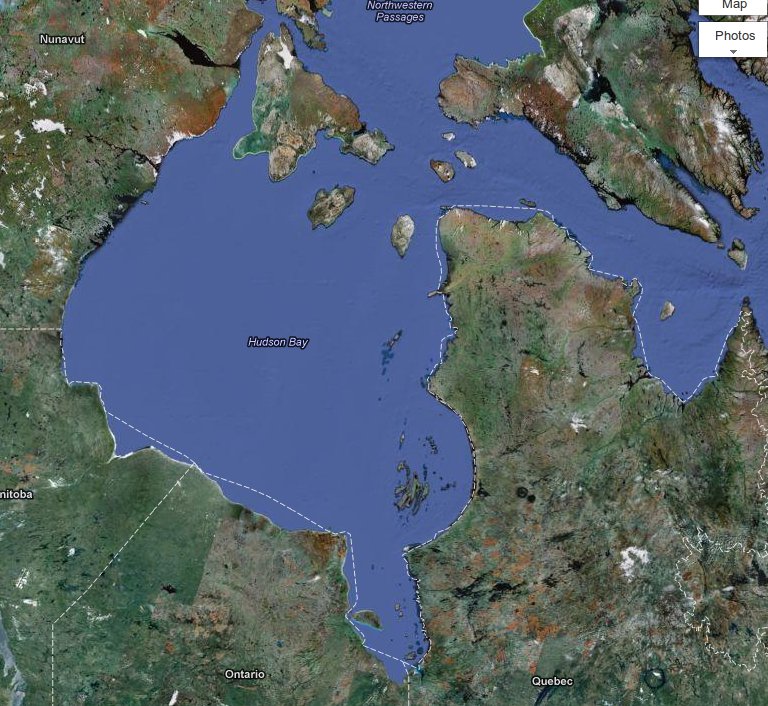
Most Canadians should know how big Hudson's Bay is, it's that big round thing that takes a bite out of the top of the country.  James Bay is the smaller Bay at the bottom of Hudson's Bay.  James Bay is 200 km across, and that's where the massive Legrand River empties, and has poured fresh water for hundreds of thousands of years, I assume.  About 200 km from the mouth of the river are the Belcher Islands.  Any effect of the LeGrand Dam felt on the Belcher Islands there would be very subtle and hard to measure.  I'm not saying that it does not exist, and there are new dams being built, but I think the film gives the impression that the islands are much closer to the mouth of the river.  I did notice that despite the Belcher Islands being only about 50 km from Quebec, thay actually are part of Nunavut territory.  Nunavut apparently owns almost all the islands in both Hudsons Bay and James Bay, a fact that I was not aware of. In the picture, you can see how close Nunavut's border is to the Quebec and Ontario shoreline, but especially Quebec.  And if you use Google Maps and zoom in, it is even closer than would appear in the large scale map, cutting off what appears to be thousands of little islands right next to the shoreline of Quebec.  Then the border of Nunavut disappears at Labrador, on Google maps anyway so I have to look that up later.  That area has to belong to somebody.

Now back to the film. The most extreme statement in the film was from David Suzuki, but it was taken off an old TV show he made, probably long before the Eider duck problem surfaced.  David was quoted as saying that 300 times the amount of water was being released due to these dams.  I have no idea what the context of this snippet was, but the fact is that the dams, averaged over a season, do not release 300 times as much water.  Hydro dams do not create water, they regulate the flow.  The biggest disruption the dams could ever make would be during the years that it takes to fill the reservoir, when the river flow is stopped.  It is not in the later ongoing release of water to produce electricity.  But because the David Suzuki documentary was not officially part of this movie, the number 300 was never explained.

The film maker, Joel Heath, did make his own statement about the ducks and the ice.  I can't remember it exactly, so to paraphrase: "It is not about more ice or less ice killing the ducks.  We don't really know what is killing them.  It could be the unpredictability of the ice."  Or something like that.  And that's the closest he came to blaming Hydro Quebec explicitly.  But this statement is played over images of ice shifting, crashing, moving about at high speed, and of course dead ducks.

I'm not at all sure that people at the Princess cinema who do not live on icy salt water shores would even know that the images were speeded up.  Maybe they did know.  But do they also know that ice shifts around all the time, with wind, tide, waves, and currents?  Any animals or birds living in this harsh type of environment have to deal with ice all the time.  And as far as I know, birds do not "predict" ice patterns.  They look for holes and use them until they disappear, then look for others.  If they don't find any holes in the ice, they may die. It's sad but true, that nature is cruel.  Ducks die all the time, with or without dams.

When I see a picture of a dead duck covered with crude oil, I am pretty sure I see a connection with the oil spill.  But when I see a picture of a duck dead under or on the ice, I'm really not that sure it was caused by Hydro Quebec releasing fresh water from a river 200 km away, especially since that river has been releasing fresh water for thousands of years before that.

It would have been useful to talk a bit more in the movie about global warming, which is an effect that is strongly felt in the arctic, far away from the Hydro Quebec dams, from Alaska to Labrador, but very little was said about it.  The lasting impression of the film is that global warming is not a big problem any more, now the real threat is the Hydro Quebec dams.  And actually, the Hydro Quebec dams minimize global warming, by producing renewable power without releasing CO2 into the air.  Why not talk about that?

http://www.theglobeandmail.com/news/arts/movies/people-of-a-feather-life-on-thin-ice/article2408055/

Sunday, April 29, 2012

Subliminal Message of The Hunger Games


Although this was not a typical movie for her, Mary Ann wanted to see "The Hunger Games" because several of her friends recommended it.  One difference for us is that this movie was being shown in a modern cineplex instead of a small old fashioned cinema in downtown Waterloo.  The cineplex charged $12.50, and asked for a donation to some dubious charity on top of that.  Then they bombarded us with loud wall-to-wall advertising after we sat down inside, something we both have a low tolerance for.  But the movie itself was good, the time passed quickly.

I was struck by the potential for propaganda in this movie.  Like many movies I have reviewed recently, "The Hunger Games" has some powerful hidden messages.  But the messages are a little too well hidden, and open to various interpretations.

I will not have any spoilers, because the important messages are all in the set-up.  There is a dystopian future for the USA, where the new country called Panem is ruled by a capitol set somewhere in the Rockies.  75 years before the time period of the  movie, a rebellion was ruthlessly crushed by the people of the capitol, who brought the other 12 districts of the country under control so harsh that people are still starving. To add insult to injury, the Capitol district insists on "reaping" new victims each year for the "Hunger Games", a reality TV show that pits children from each district against each other in a fight to the death, for the amusement of the people of the Capitol, but all the districts are forced to watch, in order to remind them of their past naughtiness and to intimidate them into submission.

I am not questioning the likelihood of a system like this ever working, as it is simply the basis for the movie's action.  But upon watching the movie, and then googling some comments, this question come up. Is it possible that Obama's policies lead in this direction?

Here are links to two different looks at the movie, one from an extreme right wing conservative website, "Voting American", with the title  "Hunger Games: Is this a Peek into a Future in which the Liberals Rule America?"

http://votingamerican.wordpress.com/2012/04/16/hunger-games-is-this-a-peek-into-a-future-in-which-the-liberals-rule-america/

I have one other website, from a Libertarian, titled "The Hunger Games movie review - a glimpse of our own future if the cancerous growth of government is not checked"

http://www.naturalnews.com/035443_The_Hunger_Games_movie_review.html#ixzz1tQpslNwK"

The right wing extremist states that the "elites" are in fact liberals, while admitting that it is not stated in the movie whether the elites are liberal or conservative.  And actually, not much more is said.  So while the movie does not claim any right or left wing bias, apparently right wing people are able to somehow see Obama's hand in the downfall of America leading up to this dystopian society.

The Libertarian review is much more thought out, actually.  In point form, we are given a list of the ways that big government will lead to this new country.

I can list them here from the Libertarian point of view

- control over food (limiting what people can eat)
- control over land (setting up huge nature conservation areas where people are not allowed to live, or hunt.) -yes blame the environmentalists
- control over the media
- control of technology (medicine, weaponry, etc.)
- control of DNA (to identify humans, and to genetically modify species)
- control over life

I actually have a harder time understanding libertarians than understanding conservatives. It seems to me that Libertarians are less connected with reality, maybe that's because they have never been in power except in their own minds. The main libertarian idea is that government and corporations are both evil, and that people must be free to do whatever they want, like the cowboys of the 19th century, when America was really great.  And most puzzling, Libertarians think the best way to achieve this freedom is to vote Republican if no actual Libertarian is on the ballot.

However, I do not agree with the analysis that says "The Hunger Games" are about socialist or liberal ideas leading to dystopia.  Let's start with "Government Control".  In general, the Conservative catchphrase "Government control" refers to taxing the rich to give to the poor.  And while conservatives don't consider military, police or harsh punishments being part of "Government control",  it's quite obvious that the problem in Panem is primarily to do with police, military, and harsh punishments.  These are not liberal policies, as liberals are often criticized by Conservatives for being too lenient.  These are Conservative militant policies.  One only has to look at the conservative support for Israel against Palestine to see the they have no problem with the basic idea of punishing a whole people for a past rebellion, with poverty, districts walled off, control of food, land and technology.

If anything, Liberals are in favour of giving health care to the poor, giving welfare and unemployment insurance, government pensions, subsidized colleges and housing etc.  Then liberals are in favour of taxing the rich to do this.  I'm pretty sure if the people in Panem District 12 were allowed to vote (another "liberal" policy - conservatives like to prevent poor people like Palestinians from voting), they would in fact vote for Obama.

The one clear indication I see in the movie of Liberal control is that the environment seems to have been saved from the destruction of global warming.   But then since conservatives believe that global warming does not exist anyway, this would only have meaning to environmentalists.

My own view is that this movie is not so much about conservative ideas of government control or regulation, as it is about liberal and socialist ideas of the class war between rich and poor.  And apparently the message is hidden well enough that many conservatives and libertarians don't get it.

Monday, February 6, 2012

A Subliminal Message in "Bruce Almighty"


Bruce Almighty appeared on basic cable last night.  This is not a review of the movie, it is more of a lesson in spotting hidden messages after you have seen the movie.  So spoilers may be coming.

Obviously this movie is somewhat controversial.  Bruce (Jim Carrey) is given the power of God, to see if he can do a better job.  Although it is a good comedy sketch, it also is playing with subjects where people are very divided in their opinions.  On one hand, you have religious extremists who believe that God exists, listens to prayers, and sends people to hell after their death.  On the other, are people who believe God is an invention to help some people to manipulate others.

With a controversial topic such as this, it is impossible to simply plow through the jokes and pratfalls without carrying some message about the nature of God, and whether He exists or not.  For example, God is portrayed as a black man (Morgan Freeman).  Already, this is reinforcing some ideas, and challenging others.  For example, many southern Baptist extremists believe God is white, to support their racist ideas.  This film portrays Him as black to skewer their fantasies.  But what about women who have been kept in their place for centuries with the "truth" that God is a man and women are not in the image of God?  Women believers will have to wait a bit longer I guess, to get a movie made for them.

Aside from the obvious statements made in the movie, there are hidden statements.  The controversy I am thinking about is the "Power of Prayer".  Many people think praying to God will give them some advantage in life, such as money or friendship.  So in this movie, Bruce is given the chance to answer prayers, and in dealing with prayer, we supposedly learn something about why God may or may not answer prayers.

The ground rules for Bruce are simple, that he only controls Buffalo New York (not the whole universe), and that he, like God, cannot alter "free will".  But even these ground rules, so simple in appearance, are loaded with hidden messages.  Let's look at the message of a regional God first. If a God can only answer prayers for Buffalo, then of course the Buffalo Sabres will win the Stanley Cup.  That makes sense, and happens in the movie.  But the fact is that already many people feel that God is a regional God, and this artificial limitation on Bruce's powers unconsciously reinforces ideas that God is for one chosen tribe only, and does not care about other people's suffering.

Nor should the second ground rule go unchallenged, no matter how obvious it may be to some.  Why is it that God cannot change a person's free will, while humans are able to?  It has been demonstrated over and over that people's free wills are easily manipulated - by flattery, by fear, by appealing to greed, and even by deception.  If people with their limited intelligence can control other people's free will, then why can't God?  So there is a hidden message in the movie that slips by without any comment - if we accept the premise that we do have free will and that even God cannot alter it, we absorb the hidden premise that no mere mortal can affect our free will.  Aside from being untrue, it leaves people open to manipulation when they absorb this hidden message.

At several times during the movie, the premise that even God cannot affect free will is tested.  Even using the power of television, Bruce cannot win his girlfriend's affection.  Funny thing though, in real life television advertising actually works wonders on getting people to believe things, and to change their supposed free will.

So in the end, of course I do not believe all the magical powers given to Bruce or God by the film makers.  That was just for comedy anyway.  But I also question the hidden messages - one of which is the message that we have free will that other people cannot change.  We need to stay aware of the potential for propaganda, advertising, and all kinds of deceitful scams - all of which can affect people's free will.

Sunday, September 4, 2011

"One Week" on DVD (Compared to "Easy Rider")


I finally found the DVD movie "One Week" at the video store for as reasonable price ($6), so I'm going to go over that trans-Canada motorcycle trip again.

Unlike "Brokeback Mountain", "Land of the Lost", "Get Smart" and "World's Fastest Indian", this movie does not have men kissing each other. But on the other hand, being a Canadian movie, we can see the Jesus on a crucifix giving us the finger. Apparently Canadians like movies that are Godless but not too gay.

I ("The Lost Motorcyclist") also recently acquired an "Easy Rider" DVD, and I have made some comparisons between the 40+ year old American movie "Easy Rider" and the Canadian "One Week". You could call "One Week" an updated Easy Rider made for Canadians and apparently nobody else.

While Easy Rider features two American Harley Davidson motorcycles, One Week features a British Norton Commando. Makes sense because we don't have a Canadian motorcycle, but many of us think we are British. Easy Rider works the US flag into the paint jobs on the helmet and the gas tank, while the Norton remains plain black and so does the rider's helmet. The Canadian movie hero is a normal person, who blends into his surroundings, while the Easy Riders contrast starkly from the people they visit.

Both movies end in death and the destruction of the motorcycles, but in the Canadian movie is is natural or accidental, respectively. Both movies involve dope, although Easy Rider goes much further with the drugs which is natural, being America of the sixties. Should be easy to guess which movie has guns (Hint: country name starts with U and ends with SA). One Week had a lot of animals featured prominently in it: The dead dog, the dead skunk in the road, the live dog on the trail, and horses to ride.

Easy Rider's soundtrack is a compilation of popular hit parade songs, "One Week"'s is made up of obscure Canadian folk or pop.

Both movies were made on a very small budget, on location, using local people for background. The Budget for Easy Rider was $400,000 in 1968, and One Week was $2,000,000 in 2008. There is no doubt Easy Rider made more money. $60,000,000 vs. $500,000. That could be why most movies made in Canada blot out the country name. On the other hand, the One Week crew got a few two-four cases of free Steamwhistle beer in return for some very subtle product placement in the movie.

Both movies feature unrealistic bikes and gear, assuming they were supposedly used for the long haul. The Norton was probably much better for riding than the chopper Harleys, but not as good as most others in the year 2008, and it was not even suitably equipped with a windshield for the cold time of year this was filmed. In a nod to realism, twice during the movie the Norton was shown to be requiring mechanical attention. Although "bad gas" would not have been in the top 100 most likely causes for a Norton to break down.

Both movies end with a bit of a verdict on their country. Easy Rider with the puzzling "We blew it". One Week with the German tourist saying "You haff one of the most beautiful countries in the vorld".

The makers of One Week must have realized a profound truth about Canadian scenery. It looks better if you shoot it out of order. Shown in the order you come to it, Canadian scenery is fatiguing. But put a little Ontario, then a shot of Saskatchewan, then a bit more Ontario, and then some Alberta, and keep mixing it up, and it is quite exciting. In a similar way, I would probably also enjoy the Canadian climate more if every other month was warm.

A part of One Week I kept noticing, because it was so different from my own motorcycle trips was the constant cell phone usage to call home. When I went on long trips, I had no cell phone, and often no way to call home at all, and I never thought about it. Same with Easy Rider, mainly because it predates cell phones. One thing I assumed was a basic part of long rides was the feeling of getting away to a new place, but I wonder if that feeling goes away as you keep chatting with friends and family back home.

Of all the songs to feature in the movie, the strangest choice in my mind is "Un Canadien Errant", the sad tale of Canadians banished from their homeland, which was sung in the original French. Or maybe it is somewhat fitting for the sadness of the terminal illness in the main character.

http://en.wikipedia.org/wiki/Un_Canadien_errant

Sunday, July 17, 2011

The Subliminal Message of Get Smart


The Get Smart movie, starring Steve Carell, Anne Hathaway and Alan Arkin, was released in 2008. Although it is just a comedy, there is a hidden liberal and anti-torture message in the movie. Before reading any further, this is not a movie review, it is an analysis of the hidden meaning of the movie and will contain spoilers.

At no time during the movie was torture used or mentioned by anyone, yet the plot of the movie is the classical torture argument. Terrorists have set an atomic bomb to go off in Los Angeles, and you have limited time to figure out where it is. Is it right to torture people to find out where the bomb is? And a secondary consideration: will torture work to save the city? So, except for the fact that the movie at no time mentions or uses torture, otherwise it is the classic scenario used in the pro-torture argument.

The hidden message of the movie is that torture does not work and is not necessary. The person who knows where the bomb is set to go off is a giant hulk, seemingly immune to any kind of physical pain. But Agent Maxwell Smart is able to befriend this giant terrorist, and find out that his marriage relationship is causing him psychological pain. In the end, before the bomb blows up, the giant sends a coded message to Max to warn him where the bomb is, and so the threat is averted.

Making torture even less likely to work in this case, the CONTROL bosses (i.e. the good guys) think Maxwell Smart is a double agent for the enemy, and therefore Max himself is the most likely candidate to be tortured, should they decide to do it. But because Max knew nothing about the bomb, torture would have been pretty much wasted on him, while the city blows up anyway. This possibility is something never mentioned in the pro-torture argument, where it is always assumed that you are "interrogating" the correct person. Instead, Max escapes custody, finds the bomb and defuses it. Obviously, if Max had actually been tortured, the city would have blown up.

A running theme through the movie is the CONTROL director (played by Alan Arkin) having less then cordial discussions with the Vice President (I assumed to be Dick Cheney) about how intelligence is supposed to be gathered. The CONTROL boss thinks the best intelligence comes from people with hunches, while the VP wants satellite data. Again, apparently no mention is made about torture, but everyone knows Dick likes torture, although he tries to not use the "T" word. Ironically, the title of the film, "Get Smart" could also be understood as a request aimed at people (like Dick Cheney) who think torture is the only way to go for intelligence gathering.

I'm not sure how popular this movie was, but I did find it in the 2 for 1 bin at my local used DVD store. So I'm not sure that many people "got" the hidden message. But even without the hidden message, I think it was worth more than the three buck I paid for it. I had a few laughs (actually laughing is not good because I'm recovering from an operation), and the next time through I had even more laughs because there are alternate joke scenes, some of which are even funnier than the original movie. For example, Agent 99 is going to chase the bad guys on a Vespa scooter, and Max is supposed to jump on the passenger seat, but instead says "wait a second I have to get some helmets and reflective vests". That made me laugh more than the original joke.

Tuesday, July 12, 2011

A Motorcycle Trip in 1977 to See Star Wars

A few days ago, I was kind of bored. My doctor says I can't ride my motorcycle for another three weeks, so I went out and bought the "Star Wars Trilogy" on DVD. Watching the first Star Wars movie brings back memories of a motorcycle trip I made in 1977.

I was reading my dad's copy of the May 30 1977 issue of Time magazine shortly after it arrived in the mail, and I badly wanted to see the new movie called "Star Wars" featured in this issue. The only problem was, the closest English speaking movie theatre that I knew of was in Montreal, 700 km away. So I waited until my summer vacation.

http://fantasticflashbacks.blogspot.com/2009/06/1977-time-star-wars-article.html

On Wednesday, June 29, I had just finished grading the Literature and Composition exams (I was a high school teacher). My wife and I were going to see the movie by riding to Montreal and back in three days on my Yamaha 250. My motorcycle was 5 years old, but it was ready for the trip with a new blue paint job, new Koni shocks, and new fairing. It had rolled up 38,500 miles (62,000 km) since I bought it, mainly driving out west a couple of times. We loaded it down with our tent and sleeping bags again and started out for Montreal and a movie. And come to think of it, I don't remember checking to see that the movie was still actually playing.

"The Lost Motorcyclist's" first mechanical problem came later in the morning, when the right baffle ejected itself from the muffler. I found it laying in the road about a hundred metres back, but could not find the missing bolt. So I used the cotter pin from the front axle nut to hold the baffle in.

Weather was the big story of the day. We had sunshine, fog, warm and cold air, rain and lots of wind. We finally found a campsite 35 km from Montreal and set up our tent for the night.

Early the next morning, we drove to the Longueil Metro parking lot, parked the bike, and took the subway to downtown, where the big movie theatres were located. We found out that Star Wars was playing at a theatre at the Hotel Bonaventure, starting a little after 12 o'clock noon. So we killed some time shopping at English book stores, which was another reason to travel to Montreal. At the first showing, not all the seats were full, but there was a huge line-up when we got out. We immediately started back to the motorcycle, planning to get as far from Montreal as possible that afternoon, as rain was in the forecast. We made it all the way to St Jean Port Jolie before we had to stop and set up our tent for the night.

Next morning, we made it to Rimouski by 10 AM, where we found out the ferry was leaving at 11 AM. Because the ferry terminal was still 100 km further, it seemed that without a hyperspace jump, we would need to maintain a 100 kph average through traffic to get there. I was actually 2 minutes ahead of schedule with only 40 km to go, when we came up behind a police car moving at the speed limit. This mind boggling delay continued for 20 km until the cruiser pulled off the road and I was free to maintain my forward momentum again. I reached the ramp to the ferry at the stroke of 11, ran in to buy the tickets, and drove on to the ferry.

Every motorcycle trip I made, I did some innovating. Looking back on this trip, I find it hard to believe that this was the first motorcycle trip where I used ear plugs. Now I can't ride without them. It was also my first trip carrying something that became another essential item: a credit card!

In those days we didn't have DVDs or even VCRs. Watching that movie again today on DVD, I can still remember why it was worth the 700 km drive to Montreal.

Friday, March 18, 2011

Howard Stern vs. Amanda Peet

By The Lost Motorcyclist, March 2011

Amanda Peet is an American actress.

http://en.wikipedia.org/wiki/Amanda_peet

What caught my attention was a youtube video posted where Howard Stern blasted her for several full minutes. After listening to the rant, I was curious as to the reason or the context of the rant.

http://www.youtube.com/watch?v=Zur0PR_-gPo

Early on in the speech, Howard says "They go on there and they clearly have nothing to talk about". An ironic statement, in my opinion.

In case you don't know who Howard Stern (the radio Shock Jock) is, http://en.wikipedia.org/wiki/Howard_stern.

"In May 1987, Stern recorded five television pilots for Fox when the network planned to replace The Late Show hosted by Joan Rivers.[65] The series was never picked up; one executive having described the show as "poorly produced", "in poor taste" and "boring".[66] Stern hosted his first pay-per-view event on February 27, 1988 named Howard Stern's Negligeé and Underpants Party."


also

"In February 1991, Stern released Crucified by the FCC, a collection of censored radio segments following the first fine issued to Infinity by the FCC over alleged indecency.[69] He released a third video tape, Butt Bongo Fiesta, in October 1992 that sold 260,000 copies for a gross of over $10 million."


Howard's approach is soft (or hard) core porn mixed with racist hatred, and a determined campaign to say things that normal people keep to themselves. He also feels that he is some kind of crusader for free speech, and a supporter of lesbian rights. Most women who appear on his show have to get naked and do things to him. So that's a sum up of Howard Stern.

Now why does he take offence at Amanda Peet's appearance on Letterman??? It seems that his own beautiful model wife appeared on Letterman earlier, and didn't do so well. So Howard decided to attack another person appearing on Letterman and Amanda Peet was at the wrong place at the wrong time. For one, apparently her parents were rich. Obviously that would not be enough for a rant like this, lots of people are born rich, and I don't hold it against them. I don't even hate Howard for making $10,000,000 of "Butt Bongo Fiesta". But the key point for Howard was when Amanda got into a fit of giggles and could not clearly state the concept of the movie she was promoting at the time. When Letterman asked her to set up the clip from the movie, she said "Now sell, Amanda, sell" and "Clearly I don't belong here". Then got into a fit of giggling, where Dave tried to fill in the background for her. So actually in a way I kind of see Howard's point, that she did not do a very good job of "selling" the movie.

But here is the point of view of a guy who lives in a more real world than Howard Stern. In Howard Stern's world, famous movie actresses take off their clothes when he tells them to and act out his fantasies on TV and radio. This, so far anyway, has never happened to me or anyone I know. I personally would be OK with being in the same room as Amanda Peet, and if she were to giggle uncontrollably at one of my jokes, I would not be offended. Even if the giggling was totally fake. And I bet a lot of guys I know would be the same way. But then I never have been paid ten million for doing a tape called Butt Bongo Fiesta, either. So my standards are pretty low.

Now let's assume I am the typical guy going to see a movie. How do you, as an actress in the movie, sell that movie to me? Well for starters, forget about telling me that the movie is about "An old Grandmother that people are waiting for her to die so they can get her apartment." There is no way you can say that to make me want to see that movie. On the other hand, if Amanda Peet is fun to watch on Letterman, and is laughing and maybe a little nervous, I might be tempted to go, especially if Mary Ann (who would never want to hear Howard Stern in a million years) want to see it too.

So I have watched Amanda Peet in a few movies, example "Saving Silverman" where she is truly a quite unlikeable person, and maybe Howard is confusing her character onscreen with her own personality. Or maybe she refused to appear naked on his show. Or maybe something else set him off.

Howard makes his fame by saying whatever comes into his mind, and his combination of profanity laced, hate filled rants, mixed with his profanity filled sexual musings seem to appeal to a lot of Americans, and many Canadians too. But I would not call it "having something to say" as much as it is simply pushing the boundaries of good taste. On David Letterman's Late Show, you have to appeal to a wider audience, and do it with taste and style. It seems to me Amanda Peet is about as entertaining as anyone, and way more entertaining to me than Howard Stern's own appearances on the talk shows to promote his satellite radio network.

Here is the offending video, (Peet on Letterman) and the selling of the movie starts at 4:40

http://www.youtube.com/watch?v=Sg_2XkgIRYU

And as a counterpoint, here's Howard's wife on Letterman, probably the original trigger for Howard Stern's hate filled rant. Somehow, Howard does not come off sounding as good as he thinks he is. Anyway, that's what I think. His wife also happens to look a little bit like Amanda Peet.

http://www.youtube.com/watch?v=NpxpEKLb_Ic

Picture: A frame grab of Amanda Peet's face from My Damn Channel featuring comedian David Wain in a Wainy Days sketch.

Saturday, February 26, 2011

Nicholas Cage can Make Love AND War

I was going to make the usual statement about spoilers, but this is a movie that simply cannot be spoiled. You know people are going to be shot, right? And there are going to be fast cars driven over the speed limit. In one of the most egregious speeding episodes, a speed limit sign of only 15 MPH is clearly visible, meaning there would be a very hefty fine for the speed they were driving (est. 150 mph)

Sometimes there is so much going on at the same time, you might miss some of it. For example, where Nicholas is shooting about 10 bad guys storming his motel room to death, and he is simultaneously making love to a hooker in 3D, you might not notice he is also chugging a bottle of Jack Daniels. I mean how is it possible to spoil a movie with scenes like that.

Normally I don't go out to such movies because Mary Ann dislikes them far more than she dislikes science fiction movies. But this afternoon I had a random blood test that told me I needed more exercise or I would be at high risk for diabetes, so I wanted to take a very long walk, much longer than Mary Ann could do. I decided to see a movie with my walk, and of course I would pick one that crammed in everything that Mary Ann does not like. To start with, it is R rated. It has guns, car chases, nudity, violence, and bad language. It has no socially redeeming features at all. Water is wasted, paper is not recycled, and I believe I even saw some styrofoam plates being used during the Infant Sacrifice scene. It would be impossible for Mary Ann to hate it any more even if it had also featured a cameo by Ben Stiller eating Chilean Sea Bass.

My only objection to the movie was the inference that Hell really existed. Five years ago I would not have cared at all, but that was before I discovered that so many religious people really believe in it. Although I don't like Satanic cults, I also don't like Christian fundamentalist cults, and even Muslim death cults. I guess I don't like any cults. The only way to tell that the cult featured in this movie was truly Satanic, was not so much that they sacrificed babies, but the way they sang a hymn in church. At first I thought they were deliberately singing it off key to avoid paying royalties to the songwriters, but then I realized there were no royalties on Christian hymns, it was sung off key to signify they were worshipping the devil.

If I had to describe the movie as a xxx meets yyy meets zzz, I would say Terminator I meets Dukes of Hazzard meets Macbeth. Instead of the General Lee (the Duke's car) they had a Dodge Charger. The Accountant (who was tracking down Nicholas) wanted to find out what kind of car Nick was driving.  I thought it was kind of strange that he asked what kind of engine it had, but not what colour it was, and I still can't figure out that one. Anyway, the Charger gets scrapped, and they find a Chevelle SS. That was the second thing in movie that I have a problem with. I just never did like the Chevelles. Couldn't they drive a nice little 1967 Toyota 2000GT like they did in James Bond "You Only Live Twice"? Of course not, as this movie was a celebration of good old fashioned American excess. Big cars, booze, guns, naked women, and religious cults.

I am going to award a special mention of thanks, in that no negative image of bikers were presented in this movie. The only biker I saw riding in the movie did not crash, which must be an all-time movie first. Especially so, in that some of the cars around him did crash.

Sunday, February 20, 2011

The Subliminal Message of "Rules of Engagement" (2000)

Last night, "Rules of Engagement" was on TV, starring Tommy Lee Jones and Samuel L. Jackson. It is a fictional movie made in 2000. But in light of what has actually happened since 9/11, I would like to consider how realistic this movie was, and whether it contained a lot of subliminal propaganda.

This opinion piece is not a movie review, and contains a lot of spoilers, so if you have not seen it, and want that special experience, stop here.

The subliminal message of this film is that being in combat in the US military makes you a decent human being, with courage and morals. The other side of the story, which I am going to state here for the record, is that often, soldiers in combat develop violent tendencies that result in killing people back home (one example Timothy McVeigh).

If this movie is propaganda, it supports the fighting men in the US military. Throughout the movie, a message is repeated, that the fighting men sacrifice their lives to protect the US citizens so that they can live free. And throughout the movie, the warriors, are honest, honourable, truthful, kind, and selflessly dedicated to their country.

This movie is a lot harder on anyone who is not a combat veteran, especially the politicians (Administration and ambassador), hard also on people who have not seen heavy combat, and pretty hard on Arabs. These Arabs are from Yemen, but in this movie, we have no reason to assume Yemenis are any different from other Arabs. All these other people, who are not the US warriors, come off as cowardly, lying, vindictive, ignorant and ungrateful wretches.

So, just to start, I would have to say that this is definitely propaganda against certain groups or races. The Democrats were in power in 2000, so I'm not sure if the Republicans are excused from the bad behaviour. Never did the film mention Democrats or liberals by name.

The two most despicable people in the film are the Ambassador to Yemen (Ben Kingsley) and the National Security Advisor. Ben Kingsley calls in the marines because a protest outside the gates of the US embassy in Yemen is getting out of hand. So the marines arrive in two transport helicopters, land under what I would call heavy fire, and the Colonel (Samuel L. Jackson) finds the ambassador cowering under a desk. The Colonel asks the cowardly ambassador if he wishes to evacuate, and Ben angrily and says yes, of course, he called hours ago, why did you take so long? etc. etc. The colonel calmly and coolly takes the Ambassador, his wife and 4 year old son to the helicopter. The colonel even carries the poor little scared boy. Remember, there is heavy gunfire all around. Then he goes back to the embassy and under heavy fire takes down the US flag, and gives it to the impatient ambassador before he takes off for safety. The Ambassador's parting words were a grateful "I'll never forget this." (to become more significant later in the movie).

Meanwhile, the battle rages with the marines left behind. Snipers on the rooftops kill three marines, and wound some others. Coming from the mob on the streets is gunfire, and when I looked at it it seemed like every person was firing a gun of some sort, including at least one woman, and including a little ten year old girl. They were also throwing rocks (no big deal of course), Molotov cocktails to cause fires, and had a battering ram which was being used to break down the gates. That was just on the streets. Meanwhile snipers on other rooftops were picking off the Marines. And I should mention that these snipers were often in the company of women and children, to provide cover.

I need to make an aside here, for the sake of considering reality. This type of all-out assault on the embassy of some other country does not usually happen. The exception I can think of is Iran back in the seventies. So that may be the inspiration for this incident. But that was a case where the entire country was in an armed insurrection, unlike the relatively peaceful Yemen portrayed here. It's hard to believe that such a huge all out attack on the embassy could have been mounted without any warning, and without any intervention by the police or military. If the Yemeni military had intervened on one side or the other, the US marines would either not have been needed, or they actually have been in a lot of trouble.

Getting back to the marines who were in a very bad situation. The Yemeni authorities (police or army) were nowhere to be seen. Although it was never mentioned in the film, obviously the marines had no tear gas or any other riot control weaponry (like rubber bullets). They had no escape route, as the helicopters had gone, but this was not stated clearly either in the movie. For sure one helicopter had left, so at least half the men would be left behind even if the other helicopter was still there.

So the s**t hits the f*n, and the colonel says "open fire". The second-in-command reminds him, hey there are women and children in among these people. The colonel repeats. "Waste the Moth*r *uc*ers", and all the marines start to fire on the crowd, killing about 80 people and wounding maybe a hundred more. Given the situation that I saw in this film, I might be tempted to call this a justified massacre. But I am no military expert of course. Apparently, there is something called "Rules of Engagement" where you are supposed to warn the crowd first, then fire over their heads, then fire only on the ones who are shooting at you. Colonel Samuel L. Jackson apparently considered none of these things. And I'm not sure they were really necessary. The situation, as I saw it, was pretty much full on warfare before the Marines opened fire.

The next part of the movie is a court martial for Colonel Jackson. The White House National Security Advisor (I guess this was supposed to be the Clinton era) decided that Jackson needed to be found guilty of murder, go to jail, and this would somehow make the USA look good in the eyes of the rest of the world. So he ordered the court martial and then destroyed the video tape from the embassy's security cameras. It turned out this tape was vital, because by an improbable series of events, all other evidence of mob violence had been lost,  cleaned up by the Yemeni police. None of the people in the embassy will tell the truth about the mob, because it would reflect badly on the ambassador for not calling the marines earlier. None of the other Marines (besides the Colonel) saw anyone in the street with a gun - and honestly this is the part I found most unbelievable.

The lying, perjury, and destruction of evidence make the court martial a mockery. In some cases, I wonder how it is even possibly to get away with this amount of lying. Surely a bit of serious cross examination would expose a few of the stupidest lies told, especially the ambassador's story. The Ambassador's story is that the mob was peaceful (!), that he refused to leave his post (!!), and that Colonel Jackson had "roughed him up" and forced him into a helicopter (!!!). Apparently not one witness could be found to discredit the Ambassador, although the ambassador's wife was contacted by the defence, and she simply stated that she would also tell lies to put the Colonel (who saved them, remember?) in jail for murder. Hard to believe that these lying, ungrateful civilians could be so evil. But that's how they were portrayed in the movie.

In the trial, it turned out that the missing video tape was documented as having been delivered to the State Department. The defence lawyer used this evidence to prove that the State Department "lost" the video. This way, they got the Colonel off all the more serious charges, and he was only charged with "Disturbing the Peace", which I guess means he woke up some people during the riot. I found it a little disturbing that in the closing comments, the defence lawyer (Tommy Lee Jones) argued that since the jury was all Marines, that they were honour bound to stand by their brother and find him innocent, comparing it to their code of honour that no marine will be left behind. That was a bit surreal.  And illegal.

In the end credits of the movie, it was stated that the Ambassador was later found guilty of perjury, and the National Security Advisor was later found guilty of destruction of evidence. This "closing credits followup" film technique is mostly used in true stories, but this movie wasn't a true story at all.